A symphony of sound: Realising writing potential in creative encounters through music, movement, sound and speech
This chapter aims to show that music and language are innately connected. It argues for the integration of music pedagogies—through music, movement, sound and speech––in English classrooms, to support young writers. Connections between music and language are being rediscovered in western-influenced scholarship, but they have long been understood in Australian Aboriginal and Torres Strait Islander contexts, and in other indigenous world cultures. Recent findings across the broad field of language sciences suggest that music and the arts have a rightful place in the Primary English classroom, rather than being a novelty. While the English curriculum provides room for music and the arts, they are not always treated as central aspects of language learning especially within scripted and constrained notions of curriculum in a growing number of Australian jurisdictions. An Orff-Schulwerk inspired music pedagogy, which emphasises creative composition, is proposed in this chapter as one way to enable interactive and ‘aesthetically-charged’ creative encounters with writing. These feature a close attention to the lyrical rhythms of speech prosody and to the generative combinatorial characteristics of language and creative writing. Classroom examples are provided which highlight practices in which children are encouraged to engage in intentional and aesthetic sound play with language at the word, sentence and text-level. Through experiments with language in improvisational contexts akin to those used in quality music education, students gain an increased sense of agency, creativity and writerly identity. This chapter presents evidence in support of The Australian Literacy Educators’ Association’s (ALEA’s) declaration that literacy is complex and multi-faceted, requiring a repertoire of multimodal practices (2023, p.1).
Introduction
From birth, children experience language as a symphony of sound. Within family and social environments before literal meaning is understood, communication may be described as an aesthetically-charged experience that is essentially musical in nature (Trevarthen, 2015, 2016). Dewey (1934/1980) has described the unique power of sound that, though coming “from outside the body ... sound itself is near, intimate ... we feel the clash of vibrations throughout the whole body”, and although “[v]ision arouses emotion in the form of interest-curiosity ... it is sound that makes us jump” (p. 237). It is this unique potential of music, movement, sound, and speech that is an important basis for language and literacy learning. A recognition of the multimodal potential of music in the literacy classroom aligns with the declaration by the Australian Literacy Educators’ Association (ALEA), that being truly literate includes the capacity to “respond critically and creatively to produce a variety of texts (traditional, multi-modal and hybrid) of personal, social, cultural, aesthetic, historical, economic and political importance” and “work confidently with multiple modes of meaning” (2023, p.1) Throughout the history of ALEA, an attention to arts-based and multimodal practices has long been championed by its educator members. This chapter serves to further advance that attention to arts-based and multimodal practices, with respect to the implications of the music-language link.
This chapter explains the compelling connection between music and language signposted across the broad field of language sciences, including in semiotics, aesthetic philosophy, education, and cognitive science;
a connection that has been rediscovered relatively recently in western scholarship (Brown, 2001, 2017; Faudree, 2012, 2017). The implications for education continue to be explored in educational research (Barton, 2020; Halcrow, 2023; Niland, 2007). As Wyse (2018) has noted, it is a connection that is still being established in educational research literature and a connection which some continue to find surprising. To support all aspects of language development, there is the need to ensure that strong connections between music and language are fostered through policies and practices that draw on music, movement, sound, and speech.
Teachers and researchers have explored the potential of music and the arts for literacy text learning. Most notably, Ewing (2010) has described the unrealised potential of the arts to transform other areas of the curriculum yet more than a decade on, that potential is being further compromised. While the Australian Curriculum: English (Australian Curriculum, Assessment and Reporting Authority (ACARA), n.d.-c) makes attempts to include music and the arts in literacy learning, the increasingly narrow policy settings adopted in some Australian jurisdictions, has minimised their application. These policy settings, which have become increasingly constrained with respect to the place of aesthetics in the teaching of English (Green, 2025), continue to ignore that when the arts are excluded from English language learning contexts, the diverse academic, multimodal, and cultural needs of students are put at risk. One of ALEA’s key roles has been to actively advocate for the kinds of literacy education which “value ... students’ worldviews, cultural heritage, home language/s and lived experiences” (ALEA, 2023, p. 2). This chapter will show that recentring
music and the arts—far from simply being a romantic exercise—is essential to the ways children learn language most effectively, and for addressing complex social, cultural and academic needs (Barton, 2020; Barton & Ewing, 2017; Ewing, 2019; Felton et al., 2016; Vaughan et al., 2011). Furthermore, this chapter provides practitioner examples of aspects of language and writing, such as grammar that could be achieved through a focus on the artful use of sound and movement, which music and the arts provide. The chapter sets out: an interdisciplinary basis for a music and language connection; the potential for music, movement, sound, and speech for the English writing context; and provides practical examples of how a music-based pedagogy may be used to support teachers in the context of literacy learning.
Music and language connections (re) discovered
Music and the arts have a rightful place in language and literacy education. This is confirmed by a growing field of research across the language sciences that shows that music and language are not only connected, but are also intertwined. The potential for this connection to enhance practical outcomes for the teaching and learning of English, including for writing is yet to be fully realised.
Aboriginal Concepts of Language and Music
In many Aboriginal language traditions, song and language are indistinguishable aspects of culture and knowledge sharing. Bracknell (2014, 2017) explains that sound, song, and language are conceived very differently in Noongar song in comparison to English. Bracknell tells us that, “the meaning is there but you can’t say what every word means; [because it is] the sound that gives you the meaning of it all” (2022, 1.14). Music, song, art, dance, and story have been essential ways of being and knowing for countless generations (Hughes, 1997; Riley et al., 2021).
After the colonising of Australia in 1788, in the nineteenth and early parts of the twentieth centuries, a facsimile version of a western- influenced British model of schooling was introduced. At the time, influential educationalists, including Dewey (1900) and Whitehead (1929), were expressing their concerns about this model. The model was also complicit in disenfranchising indigenous cultures in countries like Australia (Cole & Somerville, 2017) and severely limited the place of language, music, dance, and song that had been core to education in first nations in Australia prior to 1788.
Music and language: Tracing their connection in western thought
In Greek antiquity, one word was used to describe both music and language, mousike, and not until later in the Enlightenment did they come to be treated as distinct forms (McGrath, 2018; van Leeuwen, 1999). It was at this time that “rhetoric shifted emphasis away from performance”, and literature developed in its “silent form” (McGrath, 2018, p. 1).
While attempts to reconnect music and language have been made in the intervening centuries (Temperley, 2022), it is through contemporary social semiotic, multimodal and cognitive scientific studies that these distinctions have been shown to be learned ones (Faudree, 2012; Vanden Bosch der Nederlanden et al., 2015; Vanden Bosch der Nederlanden et al., 2020). Cognitive science research has shown that music and language are interconnected and overlapping in the brain (Patel, 2003, 2007), and share the same neural resources (Patel, 2012). Cognitive science researchers have also come to understand through biological and archaeological evidence that the earliest forms of language in human history were likely to have been a musilanguage (Brown, 2017; Mithen, 2006), neither music nor language as we would recognise them now. Other cognitive scientific studies from Trevarthen (2011), and Malloch and colleagues (1997) explored links between music and language in the relationship between infants and their carers. These researchers have shown that babies communicate, and even conduct meaning, to their carers in exchanges which have all the hallmarks of music and song, well before meaning is conveyed in a strictly literal linguistic sense. Links have also been highlighted between grammar and rhythm with implications for young children’s language learning (Gordon et al., 2015; Nitin et al., 2023). Cross (2012), and Trevarthen and Malloch (2017), highlight that music, language, and gesture are inseparable phenomena and suggest a strong, in-built social dimension to both music and language.
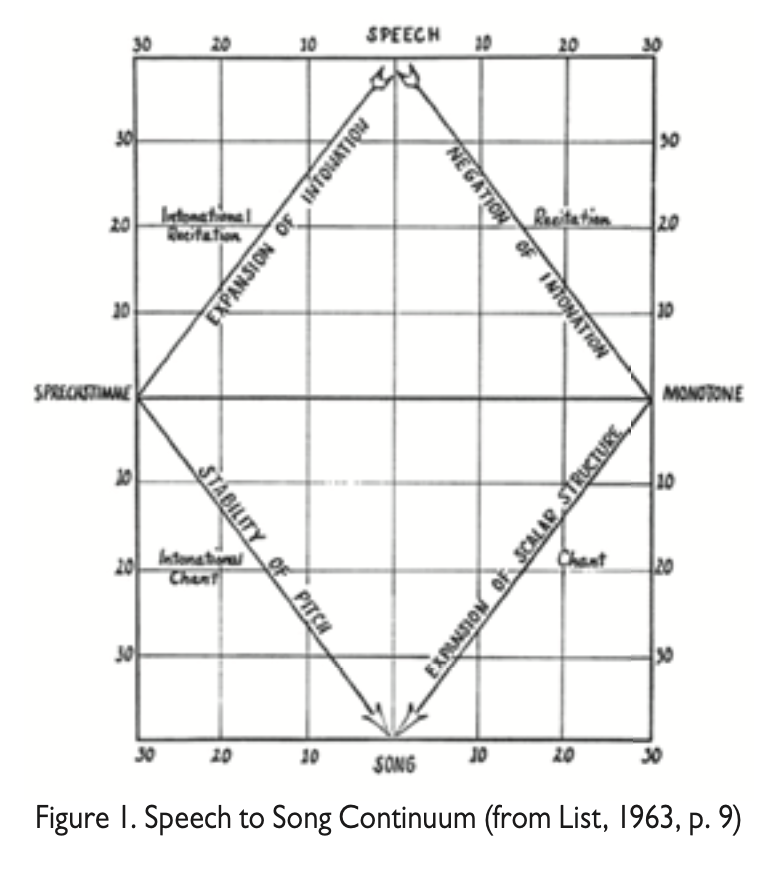
Music, language, and song sit within a continua, and are related within a “vast auditory fabric” as described by Barthes (1985, p. 77). George List (1963) explored this continuum through the differentials of modularity, intonation, and pitch (as seen in Figure 1). Figure 1 shows that the complex features of speech, chant, and song position them within a sliding scale rather than modes that are sharply distinct. More recently, others have demonstrated that these distinctions between speech and song are in fact mainly illusory. This illusion is the product of cultural learning, and is created through the qualities of repetition, rhythm, and tone rather than through any essential characteristics specific to speech or song (Chen et al., 2025; Tierney et al., 2021).
Music and language from birth
Prior to formal schooling, in early language development, the place of music, song, and dance is essential in diverse family and cultural groups (Acker et al., 2012). Dyson (1988, 1990) also highlights that young children demonstrate their capacity for music, song, dance, and other forms as symbolic languages. This includes the capacity to weave meaning through expressive forms of movement, experimental or made-up languages, drawing, writing, and role play. Similarly, Creaghe et al. (2021) show that symbolic play is the ‘fertile ground’ for literacy development.
A young child’s capacity to interpret the tone used in the music of the language (rhythm, dynamics, pitch, timbre), what might be broadly referred to as phonological awareness, is a critical foundation for children’s language development. Children who are unable to decipher these tonal elements of language experience difficulties later on. For this reason, music interventions have a positive impact on literacy skills (Dittinger et al., 2017). The capacity to effectively discern and employ speech prosody—that is, the patterns of stress and intonation in language—in addition to gesture and facial expression, are essential to everyday life and social functioning. These tonal elements of language have been shown to carry more weight than the literal meaning of words in face-to-face communication, even in adulthood (Larrouy-Maestri et al., 2024). As Ford (2022) also argues, the nuance or timbre of language is endlessly limitless and cannot be bound to a particular meaning, but instead “the infinite potentiality of timbre is manifested through each particular actualisation” (p. 572).
Language, with its tonal and rhythmic qualities, together with the orchestration of paralinguistic elements––gestural and facial expression—make the experience of language a symphonic exercise, involving many parts, all of which are necessary for discerning its meaning. This complex orchestration of movement, music, sound and speech is the reality of language into which children are born, and through which children learn to experience and make meaning.
Music and language in education
while many teachers recognise the place of music and the arts in literacy education and the Australian Curriculum, all too narrow policy settings restrict teachers’ practice, especially for the teaching of writing (Dyson, 2020). Narrow policies may limit the opportunities for arts-based and music pedagogies to enhance literacy outcomes. For example, an undue emphasis on phonemes, which receives inordinate amounts of attention in media and policy setting, does not address issues of student comprehension development (Green, 2025). Furthermore, an undue emphasis on phonemes reduces the phonological elements of language to speech sounds rather than attending to the complex tonal and musical qualities of language.
Discerning tonal nuances, in addition to speech phonemes, is core to meaning making in spoken language. Prosodic elements of language also underscore larger phonological patterns. Essentially, the rhythms of language are undergirded by the grammatical structures of speech, and are essential to interpreting and making meaning in both spoken and written texts. In order to support students to develop as confident, creative and culturally-aware communicators, and to build a new generation of creative writers, poets, songwriters, playwrights, journalists, and novelists, there are good arguments for using music and the arts in primary English classrooms.
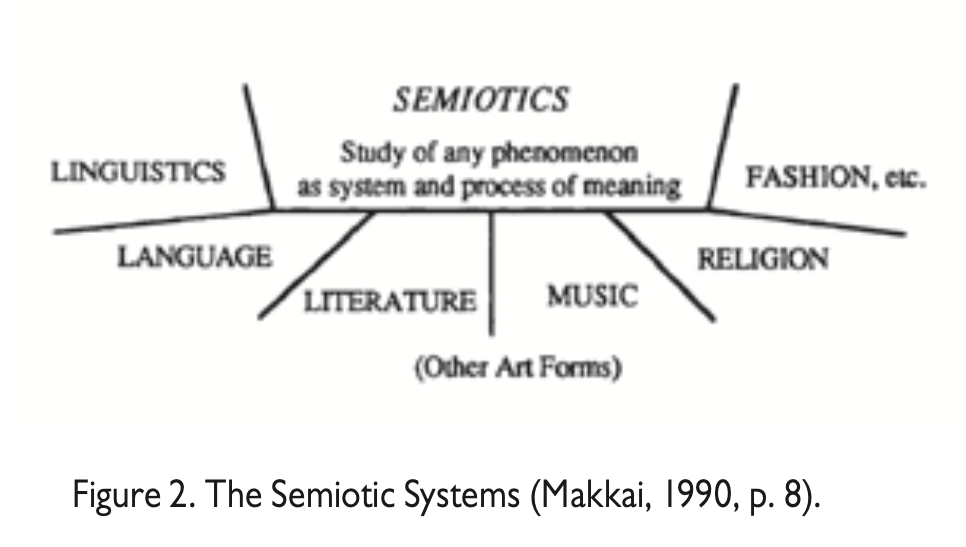
In the education context, linguist Michael Halliday (cited in Makkai, 1990) highlighted that music, language, the arts, and literature are connected as semiotic systems of meaning making as seen in Figure 2. These systems work in concert rather than distinctly.
Creativity and music pedagogy frameworks
The twentieth century German music educator and composer, Carl Orff (1963) who continues to be influential in contemporary music education (Barrett et al., 2018; Goodkin, 2001) developed an approach to education that was based on the understanding that there were inherent connections between music and language. Stories and songs were treated as a starting point, but Orff also saw that building a child’s capacity to create their own songs and stories was essential to a creative education. Therefore, in an Orff Schulwerk model (Orff 1963; American Orff-Schulwerk Association, n.d.), improvisation and composition, created in collaboration, are at the heart of classroom learning experiences. Furthermore, Orff combined other arts elements such as drama; designing a framework for teaching and learning that would begin with a prompt––a song, melody, idea or object—as a means of developing a collaborative creative work.
A number of iterative frameworks for a creative education have been proposed by scholars and creative arts educators over the last century, including from educator and philosopher Alfred North Whitehead (1929) whose ‘Rhythm of Education’ framework proposed the three iterative and cyclical ‘stages’ of romance/play, precision, and generalisation or communication. Orff (1963) proposed the broad elements of music, movement, and speech through play, imitation, improvisation, and composition (American Orff-Schulwerk Association, n.d.). While arts educator Eisner (2008) proposed inscribing, editing, and communicating as elements of an arts-based education. Each of these approaches to teaching and learning point to the key element of play, and each share an emphasis on aesthetics or experience through the arts. They are also based on the idea that these elements are essential to the ways both children and adults learn; through iterative processes of play, experimentation, and refining. These arts educators’ approaches to teaching and learning suggest transdisciplinary and interdisciplinary pedagogies are not just relevant to an arts
education. These pedagogical approaches can be used to highlight the ways we learn across the curriculum, and can particularly enhance approaches to learning in literacy.
What is an aesthetically-charged pedagogy?
A number of scholars have pointed to aesthetics as the essential ingredient for a quality education. Whitehead (1929) called it aesthetic intensity—describing true education as a moment-by-moment transformative process of becoming; one that depended on teaching and learning that was connected to reality. Greene (1984, 1986), and more recently Sotiropoulou-Zormpala and Mouriki (2020), have shown that an arts education can be dry and lifeless without the immediacy and dynamism that aesthetic experiences provide. These aesthetic experiences include both the making of and receiving of aesthetic objects. Greene calls an aesthetic experience the art of being wholly present and one that relies on “uncoupling from the ordinary” (1984, p. 124). Hong (2019) similarly explains aesthetic experiences in the poetry writing context as a defamiliarization process, one that is essential to giving creativity a chance to emerge. D’Olimpio (2024) argues that beyond moral ethical and self-expression arguments for an arts education, an aesthetics education, provides essential ways of knowing and being—critical onto-epistemologies that are foundational for education in the full sense.
A key to an active aesthetic and arts education is the principle of improvisation in the process of making and creating. Improvising is not only a jazz concept. Improvisation—and related aspects such as innovating, and experimenting—is an approach to learning. Lines (2014) refers to an expanded pedagogy of improvisation that can apply in any context. Improvisation emphasises departures from learned patterns and requires an allowance for imprecision, inexactness, and messiness. Improvisation as a pedagogical approach relies on trial and error and develops wherever risk-taking is enabled. This pedagogy of improvisation “offers hope in [the midst of] an educational climate that is riddled with coded forms of existence that work to close down possibilities” (Lines, 2014, p. 58). Others would call this play (Winston, 2013). Play has also been explored as a broader concept which points to an everyday human capacity to creatively select, edit or reconfigure elements in our space, in our language, our movement, and our thinking. Everyday acts of language and conversation may also be conceived as creative in this way.
An emphasis on imitative pedagogies, without the opportunity for improvisation, suppresses human volition and capacity for improvisation. By contrast, aesthetically- charged experiences, which music-based and music-inspired pedagogies can be used to achieve, emphasise the creative potential of improvisational interactions in the writing classroom. These pedagogies are intended to activate the imagination, to create an out-of- the-ordinary encounter with the text or artwork. Such encounters with texts can empower students to confidently act upon rather than merely to respond to works as composers in their own right.
Music composition as a parallel process to writing
All symbolic languages, including music and writing, are inherently creative, including everyday speech and communication (Maybin & Swann, 2007). Similarly, all writing forms (Wyse, 2017) involve creative processes. Children need to be given frequent contexts in which to exercise their creative capacities for language in speech and writing. When it comes to writing, Wyse (2018) explains that a viable music-writing link can be made on the basis that music is “the only other form that, like language, has both oral-sound and written forms” (p. 84). In conversations with several prolific writers, Wyse (2018) found that music was a key reference point used “to explain their craft and the processes of writing” as well as to describe their approach to the teaching of writing (p. 85).
Writing is often described as complex (Cambourne, 2015; Graham & Harris, 2017; Mackenzie et al., 2013). This complexity
includes the importance of developing an “ear” for language (Wyse, 2018, p. 82) and can be taught, but is also learned intuitively through everyday use. Embedded within the grammatical structures, tone, and style of both formal and informal written language are the rhythms and cadences of spoken language (Margulis, 2013). James Britton was a notable early advocate of the connections between oral language and writing; he visited Australia to highlight his research in the 1980s (Sawyer, 2010; Wilson, 2015). Australian studies have continued to show the importance of oral language for literacy, grammar, and writing (Exley et al., 2016; Jones, 2010); and the place of oral language through drama for developing deep rather than surface-level literacies (Cleeve Gerkens et al., 2023; Ewing, 2019). Within ALEA’s 2023 declaration, there is the recognition that a “literate person makes meaning using a range of mediums (oral, print, digital, live and multimodal) and modes”, including “words, images, symbols, sounds, gestures and embodied forms” (ALEA, 2023, p. 2).
Creative encounters with writing—A case study example in a Year 3 class (children 8 and 9 years old)
In one class context, I worked as a classroom teacher with students who were beginning to disengage with writing (Halcrow, 2023). Such disengagement is a phenomenon often cited in the research literature (Collie et al., 2016; Maynard & Lowe, 1999; McFarlane, 2019). It is generally attributed to standardised testing and the overuse of prescriptive formulaic writing pedagogies which has increased since standardised testing was introduced. To move away from these impediments to writing development, I wanted to understand how music pedagogy could revitalise approaches to writing in ways that emphasised the “sonic aesthetics” of language (Ford, 2022). A key question was: To what extent are the processes for creative composition in music and writing similar and different?
Anchored by an Orff (1963) framework, I explored a music pedagogy-inspired approach to writing using the picturebook Where the Wild Things Are (Sendak, 1963/2012) as a textual basis. Preliminary play, imitation, and improvisation with language was a basis to lead toward writing. This classic text has held enduring appeal for children and adults through the decades with its universal themes of imagination, childhood experiences of alienation and loneliness, and forgiveness. The text offers a rich imaginative world which can be brought to life through aesthetically- charged encounters with the text through interactive arts experiences enabled by music, movement, sound, and speech.
Drawing on collaborative improvisation practices from the Orff music classroom (Baker & Harvey, 2014), I used role play and a readers’ theatre strategy to bring the story to life. Working with the Year 3 students, a sound- scape was added to the reading of the text through improvised sound effects, using voice, violin, and percussion to add a sense of mood and place. Following these readings, students used the text as a basis for their own stories.
We (the students and I) began by simply retelling the story in our own words which then developed into original stories. With a focus on oral language, writing emerged naturally through shared teacher modelling, peer writing collaborations, and interactive editing—a process of developing, rehearsing and refining writing aloud—so that writing took place within the context of sound play. Teaching of the text included close analysis of sections of the text; in particular the structure of the orientation, the structure of short and very long sentences, and their purpose and aesthetic effect. One sentence from Sendak’s (1963/2012) text, which extends over ten pages, has the impact of conveying fast-moving action but also of time elapsing:
That very night in Max’s room a forest grew/ and grew/ and grew until his ceiling hung with vines/ and the walls became the world all around/ and an ocean tumbled by with a private boat for Max/ and he sailed off through the night and day/ and in out and out of weeks/ and almost over a year/ to where the wild things are (Sendak, 1963/2012, pp. 13–22).
Musically, as well as through the spoken
retellings, students expressed this through allegro (fast) violin and percussive soundscapes, while also using andantemente (flowing and continuous) music and voice. This was also a more multisensory and vivid way to conceive of the structure of the sentences and phrases—the structure of the written language—and its effect on the oral retellings and readings. As a teaching focus, in the early stages of refining, we looked closely at the orientation to the story and noticed that it contained in almost equal measure, the structural elements of plot- telling, scene and character description, and direct speech. This gave us permission to do what authors do, which is to use language in purposeful ways that work for our storytelling.
In this music-inspired pedagogy, the process of writing began in, and was surrounded by, the voice and the sounds of prosodic speech, music, and movement. An improv mindset, comparable to the jazz music or drama context, enabled the inscription or romance/playful stage of writing to feel experimental, and for students to feel comfortable with creative risk-taking.
We worked on writing as a work of intentional creative actions and experiments. Students were offered sections of the text as a scaffold from which to develop their own writing, but could discard these as they chose. As there are many aspects of Sendak’s (1963/2012) tale that are left to the imagination, there were also opportunities to write in between the lines, as it were; such as to describe what led up to Max’s wildness in the first place, or what happened during the wild rumpus. For example, a student suggested that the parent may be very controlling; deducing this from the stylings
in Max’s room, which is extremely neat and without a single toy in sight.
Creative encounters with writing—A case study example in Year 1 (children 6 and 7 years old)
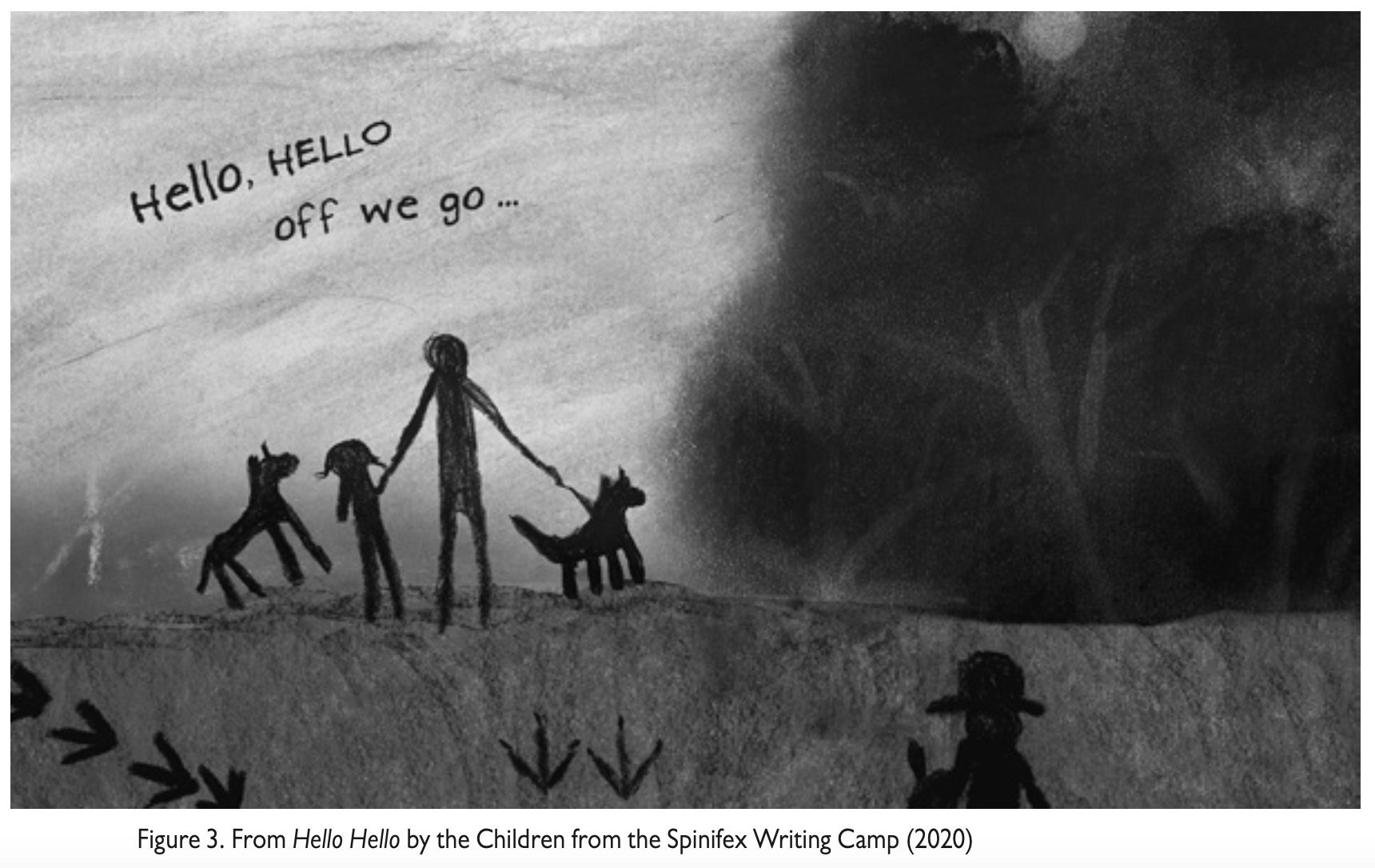
This speculative example explores possible uses of the poetic ‘song story’ text, Hello, Hello by the Children from the Spinifex Writing Camp (2020), published through the Indigenous Literacy Foundation. The book is a powerful example of a storytelling collaboration that emerged between children from the Spinifex Writing group working with an author and singer-songwriter. Poetic texts of this kind are also an excellent bridge between music and language (Beaumont, 2022), while simul- taneously affording a basis for developing improvisation in writing (Hong, 2019). Menninghaus and colleagues (2018) show that poetry, which was traditionally inseparable from song, still has a strong connection with music, so that discernible melodic contours are inherent in the structures of the language in both poetry and song through their recurrence. This recurrence is what makes both song and poetry distinct from ordinary language, and so using poetry can have similar benefits to those of song and music.
Hello, hello (2020) originally emerged in an oral storytelling context, walking on Country in south-eastern Western Australia (see Figure 3). The story is characterised by rhythm and rhyme, using poetic narrative devices such as repetition and motifs, and mimics the patterns
of a conversation, possibly between a parent or older sibling and younger children. This creative collaboration also resulted in a song which essentially puts the book’s lyrical text to music and features the voices of the children and songwriter.
Several Australian Curriculum: English content descriptors are potentially addressed through a reading and study of the text:
I can listen to and discuss poems, chants, rhymes and songs (AC9E1LE04)
I can orally retell or adapt a familiar story using vocabulary, and structure of a familiar text, through role- play, writing, drawing or digital tools (AC9E1LE05)
I can read decodable and authentic texts using phonic knowledge, phrasing and fluency, and using context and grammatical knowledge (AC9E1LY04)
I can imitate and invent sound patterns including alliteration and rhyme (AC9E1LE04)
(ACARA, n.d.-c) [italics have been added for emphasis of relevant key features]
These content descriptors could be integrated with the Australian Curriculum Humanities and Social Sciences (Geography) descriptor, to look at “the natural, managed and constructed features of local places, and
their location” (AC9HS1K03) (ACARA, n.d.-d). In addition, the Aboriginal and Torres Strait Islander Histories and Cultures cross curriculum priority understanding that “First Nations Australians’ ways of life reflect unique ways of being, knowing, thinking and doing” (ACARA, n.d.-a) could be addressed through these learning experiences with Sendak’s (1963/2012) picturebook.
The following lesson sequence demonstrates how music pedagogy elements may be applied in a Year 1 setting for a study of this text, yet these lessons do not need to be applied in a linear sequence.
Lesson introduction: Listening
Begin by asking students to listen to the recorded sounds of an Australian desert at night and ask which sounds are familiar or strange to them. Can they identify any of the animal sounds?
Ask students to audio record and take images of the sounds and sights in their own backyards at night to share with their classmates. As is relevant to the setting, a local Aboriginal or Torres Strait Islander elder could also be invited to guide families and students in understanding (including understanding the significance of) local habitats and star constellations seen from their school playground at night. Students may consider how stars and animal habitats are mapped or represented in local First Nations Australian’s songs, stories, and artwork.
Students might be introduced to the text through listening to the recorded song created by the authors and invited to sway or tap rhythmically to the song. Then, they could be asked which repeating words and phrases they noticed. This kind of activity builds phonological awareness and is an effective warm-up for students before attending to discrete prosodic and phonemic elements of language (Eccles et al., 2021).
Lesson Development: Interpreting and Rehearsing
A shared reading of the text would begin with asking for predictions about the text from the cover, the nature of the images, and the significance of the title. Questions could explore: what did the song tell them about; what might be in the book; and what they think the story is about. Students may consider that the name of the author indicates a group. The teacher may then provide background about the making of the book and information about the Spinifex region in Western Australia. The teacher may show pictures of the region and some images or videos of the writers and illustrators telling about how they created the text.
The students may be invited to read or sing repeating phrases, such as “hello, hello, off we go” (Children from the Spinifex Writing Camp, 2020) and consider the rhyming sounds and the long /o/ phoneme, including the various ways it is represented through the words of the text, such as dingo, echo, and shadow. A readers’ theatre may be developed asking students to use textual clues such as punctuation—bold text, exclamation points, and ellipses—to inform an interpretation of the kinds of intonation, rhythm, and pitch they may use when reading.
Lesson Introduction: Improvising and Composing
The teacher can begin to scaffold writing experiments with the text structure, using song, or speech. The process may be an active one that includes movement and dance elements. Pointing to the ways in which the text was originally created (i.e., walking on Country), students can walk in the outdoor environment to listen to and describe the sounds and sights, and bring these ideas back to the classroom. Working with the text, the teacher may direct attention to language features in the text, including rhyme, rhythm, and repetition, but also the use of prepositions to enable understanding of where the storytellers are in relation to the natural landscape features or the animals; for example:
Hello Hello,
What is out there we don’t know Walking in the bush we heard an echo It could be a turkey or a dingo
But what is out there we just don’t know Hello hello off we go
What is out there, we still don’t know Walking by the lake we see a strange shadow
– Children from the Spinifex Writing Camp (2020) [prepositions are emboldened]
Through reading and rehearsing the text, but also in improvising on its structure, attention can be given to the poetic structures, including the short lines rather than the use of conventional sentences, the number of syllables and rhythm of each line, and the sparing use of full stops. The significance of
a preposition could also be explored to show where the speaker is in relation to the landscape, such as under the stars or by the fence.
Students might then be encouraged to experiment in small groups, pairs, or individually with their own individual texts. They might begin to develop multimodal texts with song or spoken adaptations of the text. Students might use audio recordings of their drafts as the basis for creating their own written and visual multimodal texts in charcoal (or other) forms, such as zine or digital film stories. They might also create performance poetry or songs about their own night journey in a local environment, based on this or a similar text.
Conclusion
If music and language are inextricably connected, then music and music-based approaches have an essential place in the English classroom, particularly for writing. An aesthetically-charged context for writing
can be supported in creative encounters with an exciting text and interactions with writing peers, through music, movement, sound and speech. Creative frameworks, such as those offered by Orff-Schulwerk (Orff, 1963; American Orff-Schulwerk Association, n.d.), provide an opportunity and basis for drawing
attention to the sonic resonances of written texts, and to attune the ear to the sounds and meanings of language through performing arts, such as music and drama. Drawing on all the senses, a symphony of artful practices, which include moving bodies, singing and expressive voices, creative encounters with text are made more meaningful. As this chapter shows, aesthetic practices that build on the connections between music and language provide opportunities to support students to uncouple from the ordinary and to allow creative work to emerge.
References
Acker, A., Nyland, B., Deans, J., & Ferris, J. (2012). Young children and singing: music as a language that encourages home/centre understanding in early childhood. Victorian Journal of Music Education, 12+. https://link.gale. com/apps/doc/A322563078/ AONE?u=usyd&sid=bookmark- +AONE&xid=66e5ba1e
American Orff-Schulwerk Association. (n.d.). The teaching process. American Orff-Schulwerk Association. https://aosa.org/about/what-is- orff-schulwerk/the-teaching-process/
Australian Curriculum, Assessment and Reporting Authority (ACARA). (n.d.-a). Australian Curriculum: The Aboriginal and Torres Strait Islander Histories and Cultures cross-curriculum priority. https://v9.australiancurriculum.edu. au/f-10-curriculum/cross-curriculum-priorities/ aboriginal-and-torres-strait-islander-histories- and-cultures
Australian Curriculum, Assessment and Reporting Authority (ACARA). (n.d.-b). Australian Curriculum: English—Understanding this learning area. https://v9.australiancurriculum.edu.au/ curriculum-information/understand-this- learning-area/english
Australian Curriculum, Assessment and Reporting Authority (ACARA).(n.d.-c). Australian Curriculum: English—Year 1. https://v9. australiancurriculum.edu.au/f-10-curriculum/ learning-areas/english/year-1
Australian Curriculum, Assessment and Reporting Authority (ACARA). (n.d.-d). Australian Curriculum: HASS F-6—Year l. https://v9. australiancurriculum.edu.au/f-10-curriculum/
learning-areas/hass-f-6/year-1
Australian Literacy Educators’ Association (ALEA).
(2023). The ALEA Declaration. https://www.alea.
edu.au/about/ALEA_Declaration/
Baker, W. J., & Harvey, G. (2014). The collaborative learning behaviours of middle primary school
students in a classroom music creation activity. Australian Journal of Music Education, 1, 3–14. https://asme.edu.au/core-activities/ajme/
Barrett, M. S., Flynn, L. M., & Welch, G. F. (2018). Music value and participation: An Australian case study of music provision and support in early childhood education. Research Studies in Music Education, 40(2), 226–243. https://doi. org/10.1177/1321103X18773098
Barthes, R. (1985). The responsibility of forms: Critical essays on music, art and representation (R. Howard, Trans.). University of California Press.
Barton, G. M. (2020). Developing literacy and the arts in schools. Routledge.
Barton, G. M., & Ewing, R. (2017). Encouraging a dynamic relationship between the arts and literacy. In G. M. Barton & M. Baguley (Eds.) The Palgrave handbook of global arts education (pp. 221– 243). Palgrave Macmillan UK. https://doi. org/10.1057/978-1-137-55585-4_14
Beaumont, N. E. (2022). Poetry and motion: Rhythm, rhyme and embodiment as oral literacy pedagogy for young additional language learners. Education Sciences, 12(12), 905. https:// doi.org/10.3390/educsci12120905
Bracknell, C. (2014). Kooral Dwonk-katitjiny (listening to the past): Aboriginal language, songs and history in south-western Australia. Aboriginal History, 38, 1–18.
Bracknell, C. (2017). Conceptualizing Noongar song. Yearbook for Traditional Music, 49, 92–113. https://doi.org/10.5921/ yeartradmusi.49.2017.0092
Bracknell, C. (2022, July 6). Songs of Australia [Speech audio recording]. The Australian Institute of Aboriginal and Torres Strait Islander Studies. https://aiatsis.gov.au/about/connect-us/make- difference/songs-australia
Brown, S. (2001). Are music and language homologues? Annals of the New York Academy of Sciences, 930(1), 372–374. https://doi. org/10.1111/j.1749-6632.2001.tb05745.x
Brown, S. (2017). A joint prosodic origin of language and music. Frontiers in Psychology. 8, 1894.
https://doi: 10.3389/fpsyg.2017.01894 Cambourne, B. (2015). Understanding writing and
its relationship to reading. In J. Turbill, G. Barton, & C. Brock (Eds), Teaching writing in today’s classrooms: Looking back to look forward (pp. 26–40). Australian Literacy Educators’ Association.
Chen, Y., Tierney, A., & Pfordresher, P. Q. (2025). Speech-to-song transformation in perception and production, Cognition, 254,105933. https:// doi.org/10.1016/j.cognition.2024.105933
Children from the Spinifex Writing Camp. (2020). Hello, hello. (Children from the Spinifex Writing Camp, Illus.). Indigenous Literacy Foundation.
Cleeve Gerkens, R., Sallis, R., & O’Brien, A. (2023). Reflecting on embodied experience through an expert lens: drama as a pedagogic tool for developing academic language proficiency in the middle-primary school. Research in Drama Education: The Journal of Applied Theatre and Performance, 29(4), 600–619. https://doi.org/10.108 0/13569783.2023.228864
Cole, D. R., & Somerville, M. (2017). Thinking school curriculum through Country with Deleuze and Whitehead: A process-based synthesis. In C. Naughton, G. Biesta, & D. Cole (Eds.), Art, artists and pedagogy: Philosophy and the arts in education (1st ed.). Routledge. https://doi. org/10.4324/9781315143880
Collie, R. J., Martin, A. J., & Curwood, J. S. (2016). Multidimensional motivation and engagement for writing: Construct validation with a sample of boys. Educational Psychology, 36(4), 771–791. https://doi.org/10.1080/01443410.2015.1093607
Creaghe, N., Quinn, S., Kidd, E. (2021). Symbolic play provides a fertile context for language development. Infancy, 26(6), 980-1010. https://doi: 10.1111/infa.12422
Cross, I. (2012). Music as a social and cognitive process. In P. Rebuschat, M. Rohrmeier, J. A. Hawkins & I. Cross, (Eds.), Language and music as cognitive systems (pp. 315–328). Oxford University Press.
Dewey, J. (1980). Art as an experience. Perigee. (Retrieved from Internet Archive website: https://archive.org/details/ deweyjohnartasanexperience/mode/1up). (Original work published 1934)
Dewey, J. (1900). School and society. University of Chicago Press.