Is the art of writing under threat?
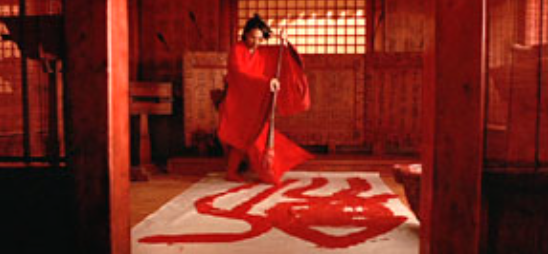
A scene from the film, Hero by Zhang Yimou. Image: Jump Cut
During the so-called Fifth Generation era of Chinese filmmaking, one film Hero (Zhang Yimou) stands out not only for the grandeur of the landscapes, gravity-defying martial arts and billowing Hanfu, but for what it asks of us. To consider the truth of the stories we’re presented and the power of those who tell them.
Twenty years on, the film highlights themes that resonate for writers, and for teachers of writing, in new ways, in the age of AI.
Hero stages a duel between two storytellers. Nameless, a would-be assassin, and the King, his intended target, compete to claim the truth of their shared imperial history. Highly persuasive in his story weaving, the king gradually wins Nameless over so that he comes to see his most hated enemy, not as a tyrant, but as a man who has suffered like him.
The creatives behind the writing of the film - Feng Li, Bin Wang and Zhang Yimou - are clearly devoted to the power of the word.
“They can never obliterate our culture.”
In one pivotal scene, a visceral test of the adage, “the pen is mightier than the sword,” an army attack a school of dedicated calligraphers. While the massive army gathers outside the city, a quiet defiance possesses the master teacher and he tells his frightened students, “Their arrows might destroy our town and topple our kingdom but they can never obliterate our culture.”
The students return to their desks as the master calligraphers wield their brushes like skilful swordsmen, even as the arrows pierce the walls of the academy and land among them. The red paint, a symbol that these strokes may be their last.
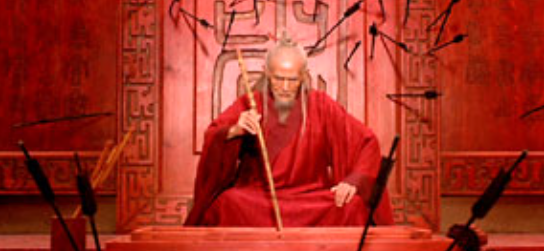
A scene from the film, Hero by Zhang Yimou. Image: Jump Cut
In the Age of AI, the artful practice of writing faces a similar onslaught.
Genuine writing seems compromised, particularly in the texts we encounter online. Imprinted with the mark of a machine formula, there is little sense of the gesture of the hand on the keyboard, and the voice of the writer seems all but lost. There is a rhythm but none of the music that makes great writing. At-scale this kind of ubiquitous writing has a deadening effect on the language.
And yet, for teachers of writing, there may be reason for hope.
After all, what AI seems to achieve is to archive the essentials of writing form and structure. It holds standards of correctness, especially for writing that requires soulless precision or a highly stylized pastiche. The kind of thing machines have always excelled at. Essentially, AI saves us time on the routine writing tasks.
Teaching writing in the age of AI
This has important implications for writers. If machines can manage the formulas of writing, then surely we now have time for those more self-nurturing, expressive, lyrical and thoughtful forms of writing? That is, writing as artform.
This also raises urgent questions about how we teach writing. Especially to young children. For example, what precedence do we now give to the mechanics of writing as opposed to the art of writing in the age of AI?
There have long been two schools of thought on this. The first, is that teaching writing to young children is foremost about the mechanics. That is, imparting a set of discrete skills - grammar, spelling, paragraphing - all aimed at achieving basic competence. These set students up for future success at school and for a job (the ‘far off’ goal).
The other, is that teaching writing should foreground writing as artform. Writing as an expression of self, of culture, and that teaching writing requires us to support young writers to develop their own unique voice (a ‘now’ goal - what we are as well as what we are becoming).
Of course, writing is both skill and artform, but here’s the crucial thing. Where you place the emphasis determines how you teach it and how your students will experience it. Whether they will experience writing as a technical exercise or as a living practice, a well for expression and creativity.
A creative way forward for the writing teacher
In the age of AI, a kind of pedagogical death knell may be sounding for skills-first writing instruction.
Formula-driven approaches that place correctness above all else are not only uninspiring but they’re now also redundant. When the common defence is made that children must “learn the basics before they can be creative,” what often follows is a kind of systematic draining of all the life force and love out of the writing classroom. Prosaic writing instruction models follow and which seem to have no sense of what writing is and was always meant to be.
Writing is an artform. A soulful echo of our vital lives.
We must teach the skills, but it’s where we place their emphasis. The teaching of writing itself is also an artform. That special relational instinct for where we might concentrate on the discrete skills, and where we might nurture the love. I would suggest that nurturing the love (the human will, which is a delicate thing) is most important.
If all we seek to do is to “get the building blocks in place” - where does it end and what is the cost? Without the opportunity to play, experiment, and be creative – which is what children always like to do in between acquiring a new skill - the life force is stripped out of writing. It becomes a dead skill.
To be clear, teaching writing as a set of grammatical rules and as a formula should never have been placed at the forefront of instruction. There is a place for these but writing should be taught first and foremost, as an artform. And all artforms must push outside the so-called rules and formulas.
Let’s leave those kinds of writing to the robots.
What does the research on writing actually say?
For further reading to underpin your teaching practice, here are some starting points:
Young children see themselves as writers before they even start school. Research. There is little distinction between drawing and writing before the conventions of the language are grasped. Young writers see drawing as integral to making their meaning understood by others Research.
Understanding grammar as a creative structural tool of the author is more important for developing confident young writers than learning grammatical rules. Research.
Within formula and rules-based writing instruction models, children can come to believe early on that they are no good at writing and inevitably their dislike and disinterest in writing grows. It stems from a fundamental misunderstanding about the nature of writing. Writing is an artform more than a set of mechanical processes. Research
For tips on teaching writing as creative artform to children, a couple of starting points including this website are:
The Primary English Teachers Association Australia: https://petaa.edu.au/w/Mp/Curric-Res/Writing.aspx
The Foundation for Learning and Literacyhttps://foundationforlearningandliteracy.info/for_educators_writing/
Michael Rosen for Teachers - Michael Rosen is a well-known