Can music do the work of philosophy?
“And we all fall down slack-jawed
To marvel at words!
When across the sky sheet
The impossible birds
In a steady illiterate movement homewards”
In western-based societies, we remain wedded to the idea that words are the only way to communicate or to think about complex ideas. Singer-songwriter, Joanna Newsom confronts this idea in her song, This Side of Blue. In a little dig at the linguistic theorists (her delicate vibrating voice throws the words ‘signified buttheads’ in their general direction), the grand ambitions for words fall short of the immanence of nature. The song implies that music has similar powers.
But what if music and song weren’t just a way to express feelings but could express ideas too? Even to actually do the work of thinking about difficult questions? And, what if sound, listening, and the stories we carry counted as rigorous ways of doing research and academic work?
These questions sit at the heart of a musico‑philosophical approach, a multimodal way I am choosing to think about music as a genuine partner in philosophical inquiry.
If you don’t usually count yourself a philosopher, stay with me here. Philosophy belongs to all of us. It is simply a tool to think through life’s big questions. Music can be a way to think philosophically to help us answer those questions, including for thinking in the classroom. And if you count creativity as central to the aims of education, then using music makes sense.
Philosophy, at least in its academic form, tends to privilege text. Arguments are constructed around words, refined, published and argued through the use of yet, more words. While I do love words, something special happens when we bring words and music together.
Words on their own, particularly in academic texts can be alienating to people who don’t always have the time. Yet, music can play a vital role in creating spaces for thinking but also to guide the substance of our thinking. Music centres our focus and brings our thinking and emotions into harmony. Music can elevate creative thought and excite vivid metaphor. These powers of the mind are often underestimated in traditional schooling and academic work.
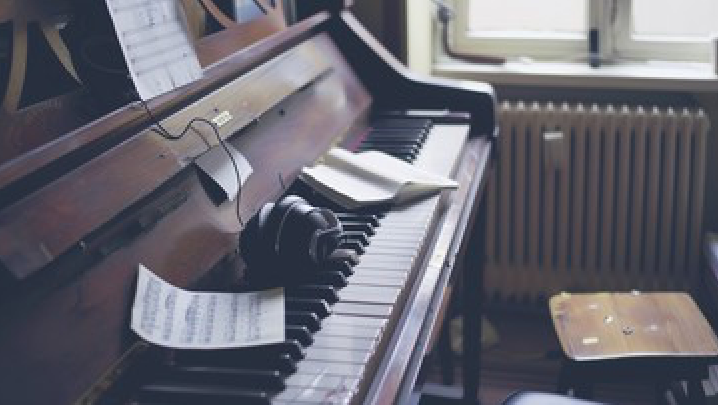
Bringing music and literature together. Source: Stockcake
Music and sonic experience offer ways of understanding the world that can’t always be captured on the page. They ask us to listen—to uncertainty, to ambiguity, to the “in‑between” moments that resist tidy categorisation.
Sound theorist, Salomé Voeglin describes this beautifully. For her, sound is an intermediary, a space where the world refuses to hold still:
“Sound is a focus on the unseen and mobile in‑between of things… In sound the world is not made of ‘this’ or ‘that,’ but is a dimensionality in which things inter-are.”
Listening and thinking through sound and music teaches us to think in motion. It draws our attention to the connection between objects and subjects rather than only seeing them in separation.
Why sonic thinking isn’t taken seriously
Despite the many sonic metaphors used in philosophy, the powerful potential of sound, music and oral language traditions are still treated as marginal to academic work. Think of terms like resonance, dialogue and polyphony - all terms designed to signal the ‘real world’ of experience.
Philosopher Bernd Herzogenrath notes this bias and argues for a shift toward process‑oriented thinking—a philosophy of becoming. The things we perceive seem solid but is an illusion that reveals the limitations of a time-bound perspective. Process philosophy is a way to recognise that everything is in a constant state of change. Philosophers like Spinoza, Nietzsche, Whitehead, and Deleuze all subscribe to this broad way of thinking. To these thinkers, the world is dynamic, relational, and event‑filled.
Music, especially process music, naturally aligns with this worldview. Steve Tromans writes in compelling ways about how improvisation—the “event” in music—pairs with process philosophy.
When music and philosophy meet: a dialogue
The term musico‑philosophical dialogue comes from Izumo Dryden, who uses it to describe how literature and music interact. Dryden sees music as having an “ontological advantage” because it allows us to sit with existential tensions by blending musical experience with philosophical reflection.
In this blog’s context, musico‑philosophy meets another longstanding philosophical tool. That is, dialogue. Traditionally, dialogue is used to unsettle assumptions, challenge fixed ideas, and hold spaces for different perspectives to intersect. Melissa Shew calls dialogue the method of philosophy, not just one method among many.
Polyphony, used most famously in philosophy, by Mikhail Bakhtin, is an approach that seeks to disrupt the dominance of a single voice. The term resonance highlights how similar ideas may echo between and across different thinkers. Nietzsche used resonance to describe the philosopher’s task: to listen for the “world symphony” and translate it into concepts.
Herzogenrath pushes this even further. For him, sound is not a metaphor for knowledge; it's a mode of knowledge:
“Sound is… a thinking of and in the world, a part of the world we live in, intervening in the world directly.”
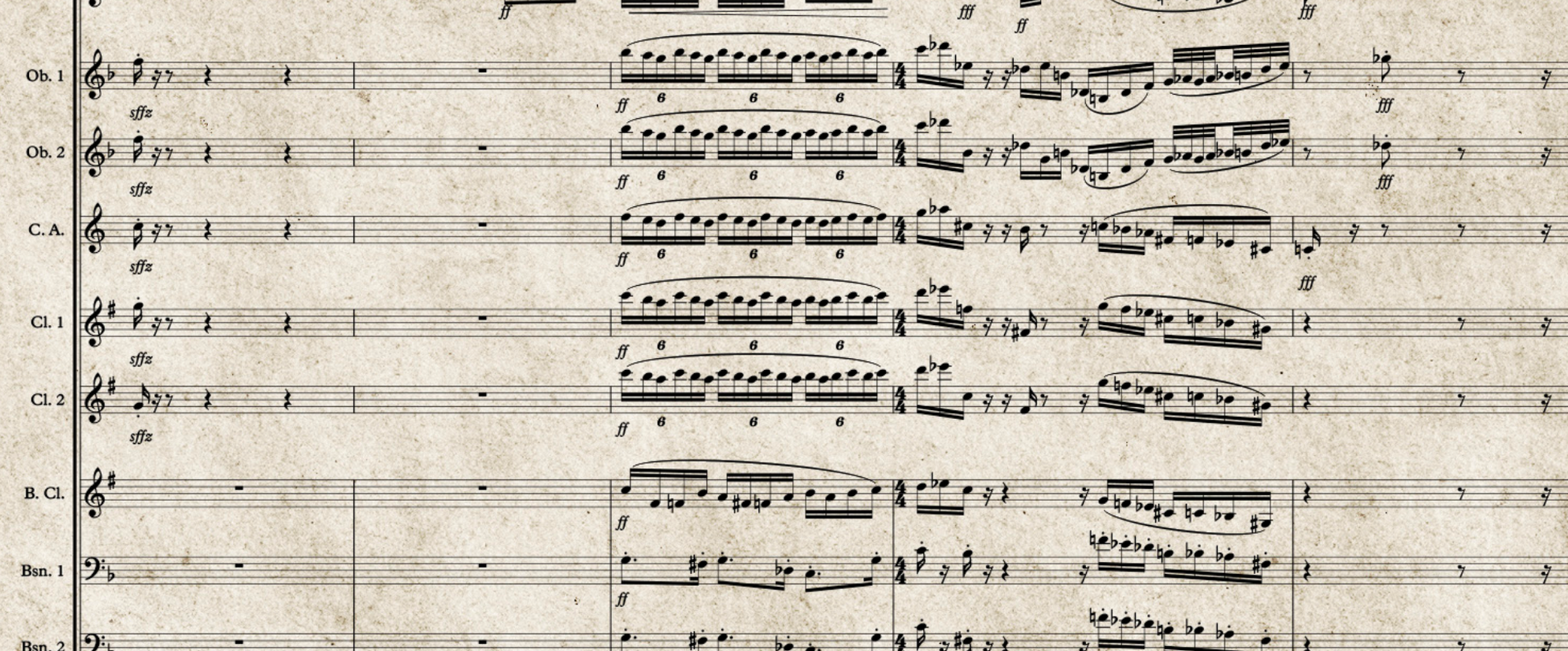
A symphonic score from children’s author-illustrator and sound artist, Matt Ottley who composes music to accompany his picture books. https://mattottley.com/music/
The challenge of writing about sound
Writing about sound is difficult, though, and this is exactly where a musico‑philosophical method becomes powerful. Rather than choosing between music and words, this approach brings them into partnership. Each mode strengthens the other. Music sharpens meaning, writing brings clarity, and both of these heighten affect (or emotional aspects of thinking). Together, they illuminate concerns neither could address alone.
Music and literature in the classroom
So what relevance might this have for classrooms?
As I said, philosophy is for everyone, and that includes for children. Asking ‘why?’ is at the heart of human experience. Classrooms can be safe and dynamic spaces for children to explore these questions. Literature, language and literacy are an essential way to develop our personal, social and cultural identities and for developing our civic participation.
Using music and language together are vital and long-held vital literacies for building expression and understanding.
Australian children’s author, Matt Ottley, a writer-illustrator and music composer explores complex ideas in ways that children can grasp and which leaves space open for dialogue. The compelling use of sound, music, image and text together have the capacity to spark thinking that acknowledges linguistic and non-linguistic ways of being.
Ottley’s stories explore themes related to creativity, courage journeys, loneliness, and family.
Introduction to Matt Ottley’s work bringing words, sounds and music together to explore big ideas and stories.
Matt Ottley’s composition for Whale Song from Teacup (Excerpt)
References
Australian Art Orchestra. (n.d.). Hand to Earth. https://www.aao.com.au/project/hand-to-earth
Dryden, I. (Fall, 2023). “The Sound of Metaphysical “Being”: Ontological Dichotomy in the Works of Musico-Philosophical Writers Fyodor Dostoevsky and Anthony Burgess,” Anthropoetics 29, no. 1, https://anthropoetics.ucla.edu/ap2901/2901dryden/.
Herzogenrath, B. (2017). “Introduction to My Edited Collection, Sonic Thinking.” In B. Herzogenrath, ed., Sonic Thinking: A Media Philosophical Approach (Bloomsbury Publishing Inc), 4, https://doi.org/10.5040/9781501327193.
Ottley, M. (2023). The sound of picture books promotional video - The sound of Venice.
Shew, M. (2013). “The Kairos of Philosophy.” The Journal of Speculative Philosophy 27(1), 54-56, https://doi.org/10.5325/jspecphil.27.1.0047,
Tromans, S. (2025). “When Being Becomes a Becoming, Everything Flows Together: Music and/as Process Philosophy” (blog), https://bigother.com/2025/01/22/from-the-archives-when-being-becomes-a-becoming-everything-flows-together-music-and-as-process-philosophy/.
Voeglin, S. (2021). “Sonic Methodologies of Sound.” In M. Bull & M. Cobussen, eds., The Bloomsbury Handbook of Sonic Methodologies, (Bloomsbury Academic), 271.